

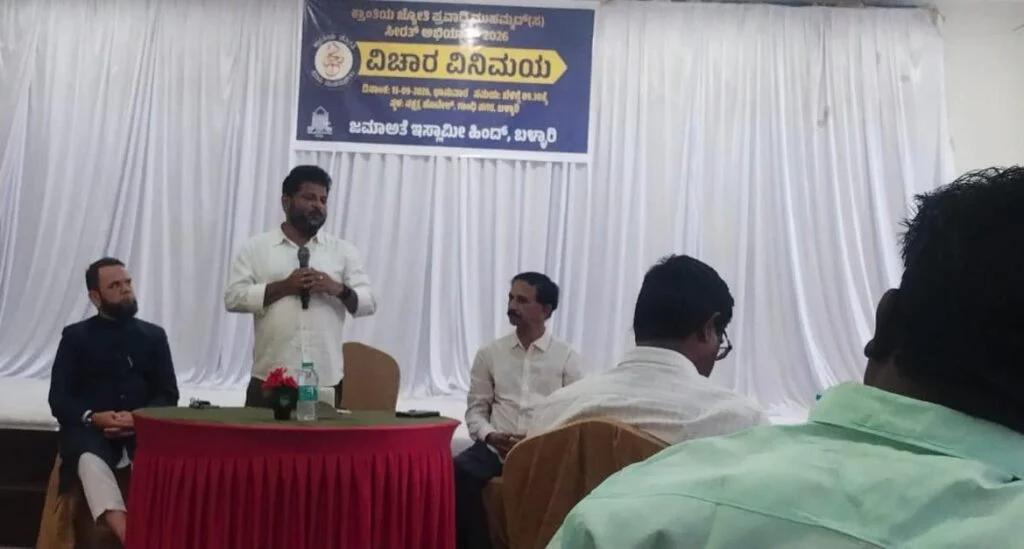
 A participant from the medical profession made an unusual comparison. Medicine, he said, has learnt to treat and repair almost every organ of the human body. “But why are we unable to change the human mind? How do we make the mind good?”
The question captured the character of a round-table interaction held in Ballari during Jamaat-e-Islami Hind Karnataka’s Seerah campaign.
Many around the table were PhD holders, academics and professionals holding responsible positions in society. They had not come merely to listen. They had questions about religion and violence, jihad, women, identity, the younger generation and the relevance of Prophet Muhammad ﷺ to the world they live in.
There was value in bringing such people together for an open interaction. Instead of discussing Islam from a distance, participants could put their questions directly to the resource person. The conversation remained cordial even when the questions were uncomfortable.
One participant went straight to a contradiction that troubles many. If religions preach peace, he asked, why does so much violence take place in the name of religion? Why the insistence that one’s own religion is superior? He also raised the question of jihad.
Muhammad Kunhi, the resource person, asked the gathering to look at violence through a wider historical lens. He referred to the two World Wars, in which millions were killed, and to other episodes of mass killing to question the tendency to view largescale violence primarily through religion. Political and economic interests, struggles for power and other forces, he argued, also have to be examined.
His response carried a point particularly relevant to the present information environment: people should be careful not to accept an idea merely because it has been repeated often. Claims need to be examined in their context and against facts. In a polarised atmosphere, that becomes even more important when the subject is a religion or an entire community. The audience, for its part, was willing to test what it heard.
A participant said he had read several books on Islam and had been particularly impressed by Islam and Woman. But he then looked at the gathering itself and raised a difficult question: if Islam accorded women the position described in its literature, why were there comparatively few women in the hall? He also questioned how the position of women in Islam differed from that within the RSS.
Kunhi responded by distinguishing equality from sameness and stressing justice and dignity for women. He questioned whether modern societies, despite an extensive discourse on women’s rights, had actually ended their exploitation, pointing particularly to the commercial use of women’s bodies in advertising. He also spoke about the place Islam accords to women’s education and participation in society.
The importance of the exchange was not whether everyone accepted every answer. The participant had read Islamic literature, appreciated some of it, and was still prepared to question what he saw before him. The speaker, in turn, had to respond to that gap between principle and perception.
Other interventions reflected concerns closer to everyday life. Teachers, parents and the growing distance created by mobile phones entered the discussion. So did religious identity and the difficulties of speaking to Gen Z. Kunhi argued that younger generations could not simply be preached at; their questions and circumstances had to be understood, and conversations had to take place in a language they could relate to.
The conversation did not remain confined to the hall. The programme received coverage in newspapers in more than one language, including Kannada and Telugu, while a fuller record of the interaction was made available on YouTube. Significantly, much of the local-language coverage framed the event around human values, peace, truth and social harmony rather than merely reporting it as a religious programme. That wider circulation gave the questions raised in the hall, and the responses to them, an audience beyond those who were present.
The Ballari interaction was also part of a wider experience for Kunhi. During the Seerah campaign, he has travelled across Karnataka, addressing and interacting with audiences from different social, educational and religious backgrounds. Speaking to Radiance, he said one feature had repeatedly caught his attention: a curiosity among people to know more about Islam and, particularly, Prophet Muhammad ﷺ.
He also sensed a change in the response to repeated anti-Muslim rhetoric. Among the people he has been meeting, Kunhi said, such rhetoric did not appear to attract everyone as it perhaps once did. People were willing to hear another account, raise questions and seek explanations directly.
That remains an impression gathered through his travels and interactions, not a measure of Karnataka’s public opinion. Hate speech and anti-Muslim prejudice remain serious concerns. But the Ballari discussion offered a glimpse of what Kunhi meant. Participants had questions about Islam, some of them difficult ones. Instead of leaving those questions outside the room, they brought them to the table.
This is perhaps where the significance of such an interaction lies. It does not require everyone to agree, nor does a cordial discussion prove that larger prejudices have disappeared. But it creates room for something increasingly difficult in a polarised society: asking a question directly and allowing the other person to answer it.
There was no expectation that everyone around the table would leave agreeing with every answer. What was evident was a willingness to ask, and a willingness to listen. In the present atmosphere, Kunhi believes even that is significant.