


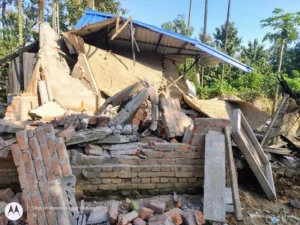
 In the dim pre-dawn haze of November 9, 2025, the rumble of bulldozers shattered the calm of Dahikata Reserve Forest in Goalpara district of Assam. For 580 families, predominantly Bengali-speaking Muslims, the mechanical roar heralded not progress, but devastation. Homes painstakingly built over decades, tin-roofed sanctuaries amid the encroaching wilderness, crumbled into rubble as excavators tore through 1,140 bighas (over 376 acres) of land contested, only for Muslim majority of the residents. One resident, clutching a faded Aadhaar card amid the dust, whispered to reporters, “We planted these trees with our sweat. Now, they’re burying our lives.”
This latest eviction drive, resuming after a poignant pause following the death of adored Assamese singer Zubeen Garg in September, exemplifies Chief Minister HimantaBiswaSarma’s unyielding ‘bulldozer justice.’ Garg, a secular icon who often proclaimed, “To me, every individual is equal, irrespective of Religion or cast” inspired a rare wave of communal harmony in his aftermath. Masses across castes and faiths vowed to reclaim unity and resist division, strengthening bonds in a fractured state. Yet, as senior journalist Abdur Rahman Aman recounted in a phone conversation on November 13, Sarma, averse to such amity, feared this solidarity. He swiftly ignited an anti-Muslim environment, claiming “Muslims don’t love Zubeen; only Hindus like him,” before unleashing the evictions to fracture the fragile peace. Framed by the BJP-led government as a triumph for environmental conservation and border security, it has instead exposed deep fissures in Assam’s social fabric. As Aman chronicled in earlier coverage for India Tomorrow, “Since 2016, more than 15,000 families, predominantly Bengali-speaking Muslims, often referred to as Miya Muslims, have been displaced by eviction drives in Assam.” His on-the-ground accounts reveal a pattern of selective targeting, procedural violations, and unchecked violence, rendering the November operation not an isolated act, but a grim escalation in a war on the vulnerable.
In a scathing letter from Guwahati/Goalpara, Abdul Hai, General Secretary of All India United Democratic Front (AIUDF), condemned the drive as a “grave violation of human rights and a brutal display of state high-handedness,” urging immediate Supreme Court and National Human Rights Commission (NHRC) intervention. Hai detailed the forced eviction of hundreds, including those with valid land deeds (pattas), and highlighted its ‘direct assault on the fundamental rights and dignity of citizens.’ While the state hails the reclamation of forest corridors to curb human-elephant conflicts, the human toll – homelessness, trauma, and eroded dignity – demands scrutiny. One may argue that Assam’s evictions, far from safeguarding ecology or identity, constitute systemic human rights abuses, contravening the Constitution (Articles 14 and 21 on equality and life) and international norms like the Universal Declaration of Human Rights (UDHR Article 17 on property) and UN guidelines on forced evictions. With assembly elections looming in May 2026, Aman’s insights underscore the drives’ electoral calculus: polarisation to secure BJP votes, without which power eludes them.
A Chronology of Displacement
Assam’s eviction campaign under Chief Minister HimantaBiswaSarma follows a steady escalation since 2021. Over 1.29 lakh bighas (42,500 acres) have already been cleared, with 29 lakh bighas (9.5 lakh acres) still marked for eviction. Goalpara district has experienced some of the worst operations.
June 2025 – HasilaBeel
- 660 Muslim families evicted from wetland settlements.
- Homes, schools, and mosques demolished despite long-standing electricity and PMAY housing.
- Evictee Anowaruz Zaman asked, “If we were encroaching, why were we given electricity and PMAY houses?” (Aman, IndiaTomorrow).
12 July 2025 – Paikan Reserve Forest
- Around 1,100 families — Deshi and Bengali-origin Muslims — displaced.
- 1,038 bighas cleared; BidyaparaJame Masjid demolished.
- An elderly resident, Anaruddin, died of a heart attack amid the chaos.
- Aman’s footage showed Azan recited over rubble and a youth collapsing in grief.
- Evictions defied:
oGauhati High Court orders for temporary shelter and food.
oSupreme Court’s 15-day notice and rehabilitation guidelines.
18 July 2025 – Ashudubi
- Police firing killed 19-year-old Sakowat Hussain; several injured, including Kasimuddin.
- Evictees resisted with bamboo sticks as shelters were torn down.
- JIH condemned the operation as ‘barbaric’; demanded judicial probe.
- MLA Akhil Gogoi, barred from the area, called it ‘illegal and unconstitutional’.
9-10 November 2025 – Dahikata
- Evictions conducted across five blocks, demolishing 588 structures.
- Deputy Commissioner claims 15+ days’ notice and 70% voluntary vacating.
- Media reports contradict this; in earlier Hasila evictions, notices were only two days old, even during school exams.
Abdul Hai’s findings:
- Bhatiapara Village – 110 families evicted, including holders of valid Pattas.
- DashabhujaDevasthan Village – 370 landless families displaced again after earlier river erosion, without rehabilitation.
- Contradictions with UN-Habitat guidelines, which require alternative housing before evictions.
Timing: Pre-winter and ahead of local polls – politically charged, echoing Aman’s assessment of polarisation before the 2026 elections.
Human Impact: Voices of the Displaced
The rubble of Dahikata tells tales of quiet endurance upended. These families, many settled since the 1980s after Brahmaputra floods eroded ancestral lands, cultivated modest plots in the forest fringes. Eviction stripped not just roofs but livelihoods: Small farms gone, children out of schools razed in prior drives, women shielding infants from the chill. In makeshift camps under tarpaulins in Paikan, hunger gnaws; no water, electricity, or medical aid arrives, breaching UDHR Article 25 on adequate living standards.
In July, Fazal Ali, a Muslim journalist, live-streams from his bulldozed Paikan home, grief-stricken amid wreckage.“This is not eviction; it’s erasure,” Ali said, echoing broader sentiments of generational betrayal. Elderly evictees, pregnant women, and disabled, vulnerable per ICCPR non-discrimination clauses, suffer disproportionately, with unreported suicides and heart failures compounding the toll. Hai amplifies the educational fallout: The 1947-established Luptachar Primary School was shuttered, denying children’s fundamental Right to Education under Article 21A. Matriculation candidates now face ‘extreme uncertainty,’ homeless and exam-preparing in fields, with the government ‘showing no concern.’
Discrimination permeates: Sarma’s rhetoric brands evictees ‘Bangladeshi infiltrators,’ despite voter IDs, PAN cards, and NRC links proving citizenship. Aman’s June coverage of pushback operations – deporting 700+ to flooded no-man’s-land without due process – highlights this xenophobia, violating Foreigners’ Tribunals’ sole authority. All Assam Minority Students’ Union (AAMSU) President Rejaul Karim Sarkar calls it ‘illegal and inhumane persecution,’ branding minorities foreigners to stoke fear. In Dahikata, as X user @SharpMediaNetx posted, “Assam’s Bulldozer Evictions: A Grave Attack on Muslim Families and Their Rights, Leaving Hundreds Homeless.” Psychological scars linger: Children traumatised, communities stigmatised, dignity shredded in a state where Muslims form nearly a third of 35 million souls.
Government Justification vs. Critiques
Officials tout Dahikata as ecological salvation. Special Chief Secretary M.K. Yadava emphasised restoring elephant corridors, reducing man-animal conflicts. Sarma, in a November 7 Facebook Live, vowed no retreat from ‘land, law, or identity,’ dismissing opposition as instigating ‘Nepal-like unrest.’ The Gauhati High Court greenlit the drive post-petitions, with Timung noting its ‘peaceful’ execution. Yet, as Aman detailed, Sarma pledged to persist until ‘whole land is cleaned of the ‘Miyas’,’ warning their population – projected at 38-40% in the next census – threatens to “capture Dispur, hence whole Assam.” Pressed on evictees’ fate, he retorted, per Aman’s account, “That is none of my business… I am keen on erasing the Miyas from Assam and settle the indigenous Assamese on the evicted land.” This echoes his recent vow: “Illegal Miyas can’t have peace till I am CM,” says Aman.
Critiques dismantle this facade. Aman’s July reports expose selective fury: Hindu encroachments often spared, while Muslim sites – mosques, Eidgahs, graves – are razed, contravening equality under Article 14. In Dhubri’s solar project clearances, 4,000 bighas targeted Adani Group land, but evictees got no alternatives. Hai’s letter corroborates: The drive “reportedly targeting only Muslim communities, while non-Muslim communities in the same area remain untouched,” with no adequate notice or demarcation. When Hai sought proof from the Forest Department that the land was indeed forest reserve, he was detained for eight hours at Mornai Police Station, underscoring ‘an attempt to suppress dissent.’ Human Rights Watch has likened India’s ‘bulldozer justice’ to collective punishment, echoing Aman’s documentation of barred MLAs and detained protesters like Saminur Ali for ‘inciting hatred.’
Historically, Assam’s anti-immigrant fervour, from the 1980s agitation to NRC’s 1.9 million exclusions without appeals, fuels bias. Opposition Leader DebabrataSaikia’s May letter urged halts per Supreme Court, yet drives persist. Pre-2026 poll polarisation, as in June’s Hasila drive amid voter realignments, are to frighten Miyas and consolidate Hindu support.
Social and Broader Implications
The Dahikata evictions ignited a digital flashpoint: #AssamEviction trended as mocking videos branding residents ‘illegal Bangladeshi Muslims’ clashed with posts condemning ‘extremist Hindutva’ demolitions. This online polarisation reflects tensions on the ground. AAMSU protests, documented by Aman, echoed fears of a repeat of Darrang 2021. The fragile unity seen after Zubeen Garg’s death quickly dissipated as political rhetoric deepened communal divides.
Demanding Dignity and Dialogue in Assam
Assam’s forests may reclaim Dahikata, but the human scars run deeper. Aman’s reporting, from pushback deportations to July’s fatal firing, shows an eviction regime where coercion overtakes compassion and political polarisation eclipses constitutional duty. Hai’s urgent intervention underscores the cruelty of evictions carried out without any “humane rehabilitation plan”, punishing erosion-displaced families and extinguishing children’s futures in closed schools.
Accountability must replace impunity. A moratorium on all evictions without rehabilitation is essential. Independent judicial inquiries are needed into the Ashudubi firing, demolition of Patta land, and procedural violations across Goalpara. The Supreme Court should take suo motu notice, halt further demolitions, and enforce its own safeguards. The NHRC must send a fact-finding team to investigate rights violations and the misuse of police power, such as the detention of Abdul Hai.
Most importantly, the voices of the displaced must be centred. As Aman records them insisting, “We are genuine Indian citizens.” Assam’s stability will not be secured by bulldozers, but by justice, empathy, and dialogue. Without this shift, the wounds of displacement, not the regrowing forests, will define the state’s approach to the 2026 elections.