

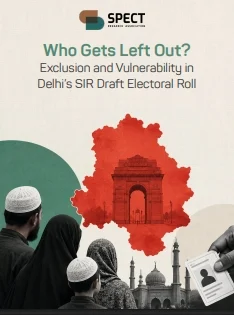
The preliminary report by SPECT Research Association, titled “Who Gets Left Out? Exclusion and Vulnerability in Delhi’s SIR Draft Electoral Roll”, has found that a large and unevenly distributed number of previously registered voters are missing from Delhi’s draft electoral roll following the Special Intensive Revision (SIR) process. The report focuses primarily on the Tughlakabad and Okhla Assembly constituencies, which recorded the highest exclusion rates, along with a random sampling of polling parts from other constituencies to examine broader patterns.
According to the report, Delhi had approximately 1.45 crore registered electors before the SIR exercise, compared with 97.53 lakh names in the draft roll – meaning around 47.6 lakh names, or 32.8 per cent of the previous electorate, do not appear in the draft. The report notes that these exclusions cannot yet be treated as final deletions, but says their scale and uneven distribution raise questions about the inclusiveness and reliability of the enumeration and verification process.
The report finds the exclusion highly uneven across the city. Thirteen Assembly constituencies recorded exclusion rates of 40 per cent or more, led by Tughlakabad at 47.8 per cent and Okhla at 45.2 per cent, followed by R.K. Puram (44.4%), Kasturba Nagar (43.9%), Kalkaji (42.7%) and Badarpur (42.5%). New Delhi, Jangpura, Mehrauli, Patel Nagar, Sangam Vihar, Karol Bagh and Patparganj also recorded rates of 40 per cent or higher, compared with roughly 16.5 per cent in Rohini and 18.7 per cent in Shakur Basti. The report notes that the highest exclusion rates span a mix of Muslim-concentrated constituencies, SC-reserved constituencies, resettlement colonies and dense working-class settlements with sizeable migrant populations.
The report says constituency-wide averages mask even larger swings at the level of individual polling parts. In Tughlakabad, nine sampled polling parts had 10,187 registered voters in 2025, of whom only 3,756 appear in the SIR draft, leaving 6,431 voters, or 63.1 per cent, absent. Eight of the nine parts lost more than half their previous electorate, six lost over 60 per cent, three lost over 70 per cent, and one lost more than 80 per cent.
Some of the steepest declines were found in vulnerable settlements: two parts covering Janta Jeevan Camp and the adjoining Okhla Industrial Area Phase II recorded exclusion rates of 72.6 and 72.4 per cent, together losing about 72.5 per cent of their combined 2,796 previously registered voters. Three sampled parts in Pul Pehladpur showed a combined exclusion rate of 60.7 per cent, while in Harkesh Nagar, exclusion ranged from 29.3 per cent in one part to 64 per cent in a neighbouring one – a gap the report says shows how constituency-level figures can obscure highly localised concentrations of exclusion.
A similar pattern was found in Okhla, where the constituency-wide rate of 45.2 per cent marked a combined exclusion of 55.25 per cent (7,958 of 14,403 voters) across eleven sampled polling parts. Taimoor Nagar’s two sampled parts recorded a combined 75.78 per cent exclusion, Khizarbad Village recorded 74.82 per cent, and two Batla House parts recorded 58.72 per cent, with significant reductions also seen in Zakir Nagar, Haji Colony and Joga Bai. Across the eleven Okhla parts sampled, exclusion ranged from 26.57 to 76.99 per cent.
Random sampling elsewhere reinforced the pattern of unevenness, with Burari’s sampled parts ranging from 17.7 to 55.6 per cent exclusion, Shalimar Bagh from 22.8 to 66.1 per cent, and individual parts in New Delhi, Matia Mahal and Kalkaji approaching or exceeding 50 per cent. The report concludes that the defining feature of the SIR draft is not simply the overall scale of exclusion, but its extreme geographic unevenness.
The report identifies migrant workers, tenants, poor and working-class households, residents of informal and unauthorised settlements, elderly citizens, women who have recently changed residence, students and young adults, homeless people, and those with limited digital or bureaucratic literacy as groups particularly vulnerable to exclusion, noting that these populations may face greater difficulty with address-based enumeration and the administrative process for correcting omissions.
SPECT Research Association says the Delhi SIR draft raise concerns not only because millions of previously registered voters are missing from the draft, but because the burden of correcting these exclusions may fall disproportionately on citizens already vulnerable to administrative invisibility. The report calls for a transparent claims process, proactive outreach in severely affected areas, and closer, independent scrutiny of high-exclusion polling parts to ensure the roll revision does not deepen existing inequalities in electoral participation.