

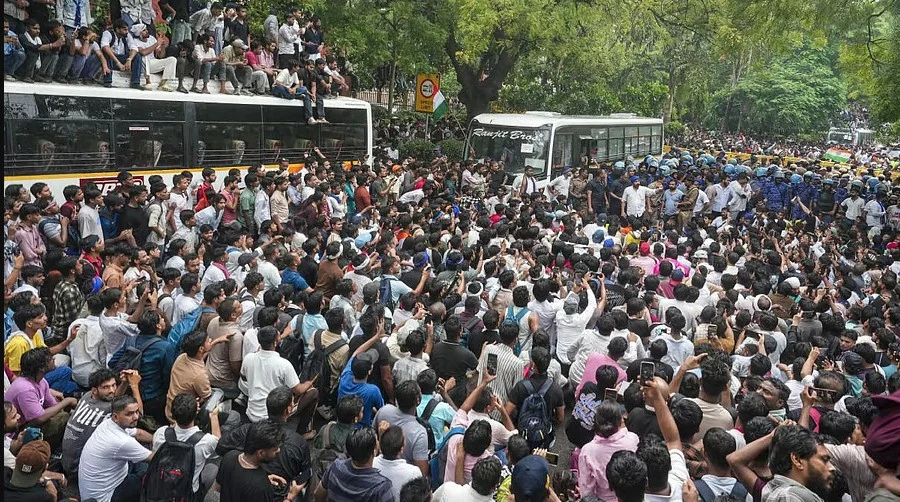
The Student Protest 2026 at Jantar Mantar has raised an important question: how does today’s student movement compare with the Anna Movement of 2011?
The Anna Movement took place in an atmosphere where people participated openly and without the same level of fear and uncertainty that many protesters appear to feel today. Even though political leaders and political parties extended their support to the movement, there was comparatively less public debate about whether a political party had captured or taken control of the protest.
Today, however, the situation feels different. If a political leader joins the Student Protest 2026, an immediate allegation is often made that the leader or political party is trying to ‘capture’ the movement or take political control of it. This creates an unusual dilemma: political leaders are criticised if they do not participate, but when they do participate, questions are raised about their intentions. In a democratic society, political support for a public cause should not automatically be viewed as an attempt to hijack or capture a movement. At the same time, the independence of a student movement must also be protected so that its core demands remain above partisan politics.
Many participants are also concerned about FIRs, surveillance, cameras, and facial recognition. There is a perception among some sections of society that participation by Muslims could give the protest a communal colour. Because of these concerns, some members of the Muslim community may be hesitant to participate openly. This is one of the major differences between the two movements.
The Anna Movement also appeared to have a more visible channel of dialogue with the Government of India. The present student movement, on the other hand, has witnessed serious concerns over the use of force. Reports and allegations regarding lathi charges and alleged misbehaviour with women protesters have further intensified public debate.
The present student movement has also raised serious questions about the conduct of some individuals seen alongside the police during the protest. Students are asking: Who were those people in civilian clothes who were allegedly seen hitting protesters with lathis alongside the police? Were they police personnel, security personnel, or someone else? If they were part of the law-enforcement operation, why were they not in uniform or clearly identifiable? These are legitimate questions being raised by students and protesters, and the authorities should provide a transparent explanation. Accountability and transparency are essential whenever force is used against peaceful protesters.
Even now, questions are being raised about the identity of some personnel seen during the protest. Some people are asking: Who were those individuals in plain clothes? Why were some police personnel allegedly without visible nameplates? These questions deserve transparent answers from the authorities.
Another important question concerns representation and leadership. Where is the visible leadership of women in the Student Protest 2026? A movement that seeks to represent students and citizens should strive for broad and inclusive leadership, with adequate representation of women and diverse sections of society.
There is also another concern that deserves discussion. The Anna Movement eventually saw some of its prominent activists enter electoral politics and form a political party. This has led some people to wonder whether the leaders of today’s student movement might eventually follow a similar path. This is not necessarily a criticism, but it is a legitimate question that the public may ask when a movement becomes large and influential.
Despite all these concerns, the Student Protest 2026 has demonstrated remarkable strength. The fact that students and citizens continue to participate despite fear, uncertainty, and pressure is itself significant. During the Anna Movement, a large number of people from the entertainment industry and Bollywood openly joined the streets. The level of celebrity participation in the present movement may be different, but the courage shown by students should not be underestimated.
It is also important to understand that a protest associated with a particular community can sometimes be suppressed or portrayed through a communal lens. But the Student Protest 2026 has, in many ways, moved beyond such narrow identities. Its strength lies in the fact that it is increasingly being viewed as a broader issue concerning students, accountability, transparency, and the future of the country.
The Government of India should therefore engage seriously with the students and address their genuine concerns. A healthy democracy requires dialogue, accountability, and the freedom to raise questions. If students’ legitimate demands are addressed today, it can also create a stronger culture of accountability within government institutions in the future. Officials and authorities should know that administrative failures and irregularities will be questioned, and that accountability cannot be avoided.
Ultimately, the students’ demand is simple: they want transparency, accountability, justice, and a fair opportunity to be heard.
The Government should listen to them not as opponents, but as citizens and the future of the country.
[Abdullah.kashif0007@gmail.com]