

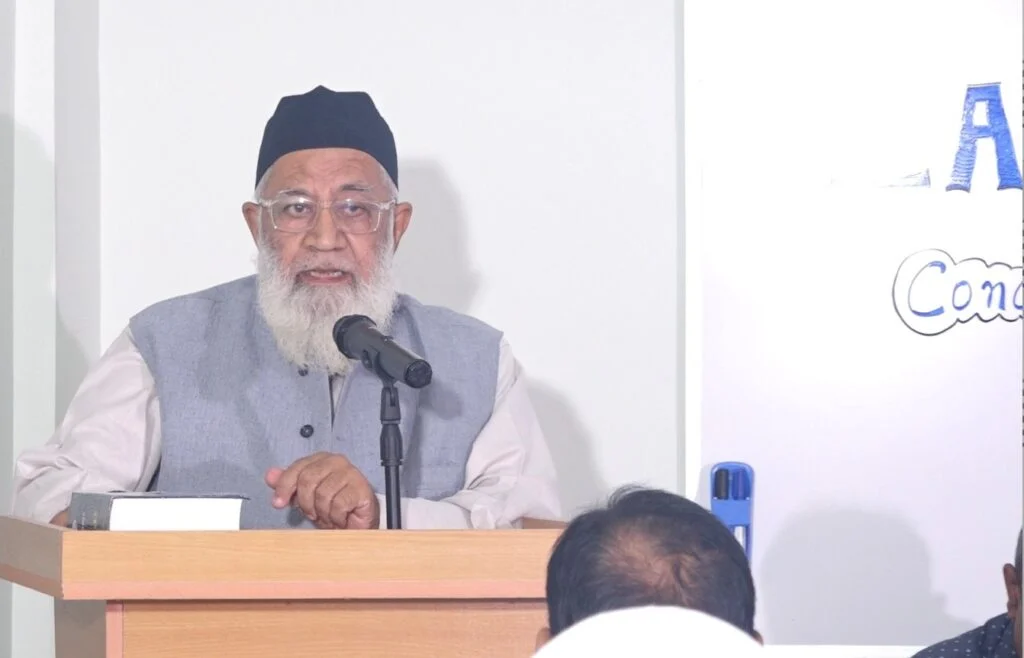
 Islamic scholars and financial experts opined that Zakat should not be confused with government-levied taxes, emphasising that they are two separate obligations and both must be paid. A galaxy of scholars expressed these views during a symposium organised by the Institute of Tax Accountants (IOTA) in Patna on Wednesday.
The theme of the symposium was “Zakat and Taxation: Concepts, Comparison, Common Good,” bringing together Islamic scholars and finance professionals for an interdisciplinary discussion.
Speakers explained the concept of Zakat, highlighting it not merely as a financial obligation, but as an institution rooted in piety, the purification of wealth, and social responsibility. They distinguished Zakat from taxation in terms of their respective sources, nature, and purposes, while also examining their shared concern for social welfare, economic justice, and the common good.
In his concluding remarks, Dr.Waquar Anwar said paying Zakat is a purely divine and religious act, leaving no debate over its validity. He noted that while taxes can be planned to minimise financial obligations, there is no option to reduce or avoid paying Zakat once a person meets the prescribed threshold of wealth and time. He also clarified that calculating the timeframe for Zakat must be based on the lunar calendar rather than the solar calendar.
S.S. Quadri detailed who is required to pay Zakat and the permissible heads of expenditure for its collection. He reiterated that tax and Zakat serve distinct purposes, clarifying that Zakat cannot be set off against taxes, nor vice versa. “It is completely wrong for someone who is required to pay Zakat to think that paying a certain amount in taxes can be adjusted against their Zakat obligation,” explained Mr. Quadri.
Mufti Sanaul Hoda Quasmi noted that India is a pluralistic country and emphasised that every citizen is required to pay taxes for the common good, such as infrastructure, healthcare, and public welfare schemes. He stressed that paying Zakat is a Fard (obligatory duty) decreed by Allah, with a clear-cut list of designated beneficiaries.
Mufti Ehtekamul Haq Qasmi explained the theological foundation of Zakat and its paramount importance in Islam. The deliberations also covered various international models and approaches regarding Zakat and taxation. Zakat was discussed through religious, ethical, and socio-economic lenses, while taxation was examined within the context of public finance, redistribution, and broader social and political dimensions.