

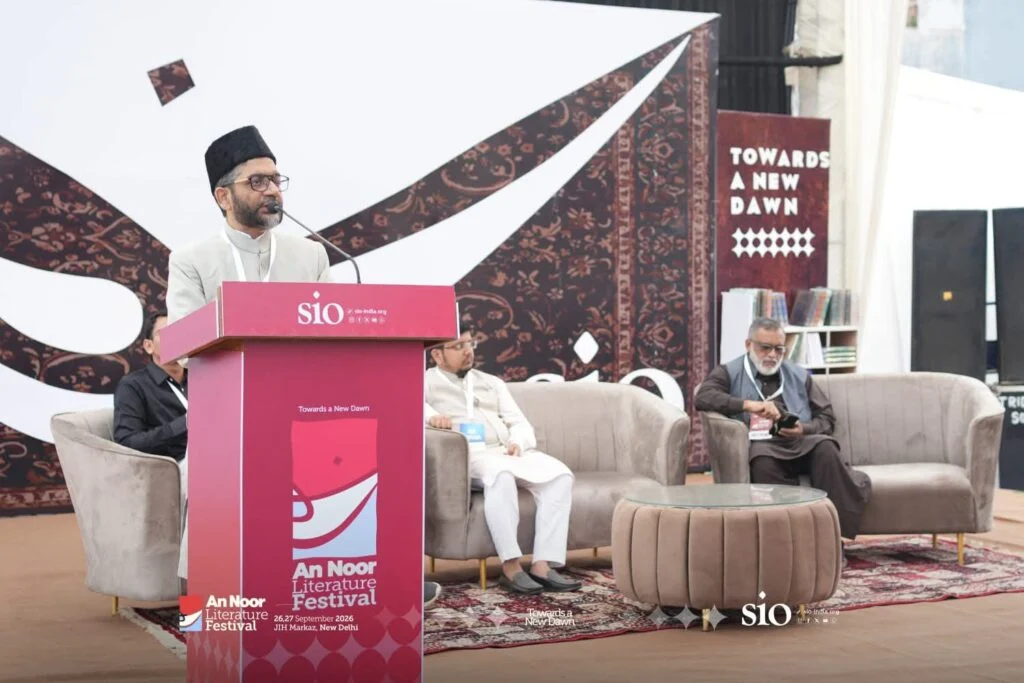
The Students Islamic Organisation of India (SIO) organised a two-day An-Noor Literature Festival on September 26 and 27 at the Jamaat-e-Islami Hind headquarters in New Delhi. The festival brought together discussions on literature, art, culture and ideas, with a focus on encouraging young people to engage with creativity, intellectual inquiry and social concerns.
Addressing the inauguration session, Jamaat-e-Islami Hind President Syed Sadatullah Husaini delivered a keynote address titled “Towards a Grammar of Liberation: Thinking Islam in the Postmodern Condition.” He said Islam offers a vision of ‘complete liberation’ that goes beyond freedom of choice, consumption and political rights.
Husaini began by recalling his participation in an earlier edition of An-Noor and praised the creativity and aesthetic sensibilities of young people. He said the festival provided an opportunity to connect moral, spiritual and cultural values with literature and creative expression.
The central theme of his address was the meaning of freedom and liberation. Husaini examined the development of modernity and postmodernism and their approaches to human freedom. According to him, modernity emerged partly in response to oppression associated with traditional authority, religious elites and authoritarian rulers. It sought to liberate people from superstition, inherited authority and social hierarchies.
However, Husaini argued that modernity subsequently elevated certain ideologies and institutions into universal truths and attempted to apply European models across societies. He said this created new forms of absolutism and constraint.
Postmodernism emerged partly as a response to such absolutism. It questioned who possessed the authority to define truth, knowledge, identity and reality and drew attention to voices and experiences that had been marginalised. Husaini acknowledged that this helped create space for alternative identities and perspectives.
Nevertheless, he argued that postmodernism left a fundamental question unanswered: “Liberation for what?”
To explain his argument, Husaini proposed three dimensions of liberation: ‘liberation from, liberation of and liberation for’. He said modernity largely addressed liberation from oppression, superstition and inherited authority, while postmodernism concentrated on the liberation of suppressed voices, identities and experiences. The deeper question, he maintained, concerns the purpose of freedom and the direction in which humanity should proceed after achieving it.
Husaini linked the meaning of freedom to the definition of the human being. If people are viewed primarily as consumers, freedom may become freedom of consumption. If they are seen mainly as individuals, it may be reduced to freedom of choice, while political or economic approaches may define freedom mainly through political and economic rights.
He warned that reducing human beings to any single dimension could itself create another form of confinement. A person may possess choices while remaining controlled by desires, he argued.
He particularly highlighted the influence of consumerism, advertising, social media, entertainment and algorithms in the digital age. These forces, he said, increasingly shape people’s desires, perceptions and choices. He questioned whether choices can truly be autonomous when desires themselves may be influenced or manufactured by external systems.Husaini described contemporary society as moving from an age of ‘grand narratives’ towards what he termed ‘grand control’. He argued that digital platforms and commercial systems can influence not only what people think but also the range of ideas and possibilities they encounter.
As an alternative, Husaini presented Tauheed, or the oneness of God, as the foundation of Islamic liberation. He argued that submission to one God does not represent a denial of freedom but can free people from enslavement to desires, social pressures, ideologies, markets and technological influences.
According to him, Islam seeks the liberation of both body and soul. Genuine freedom therefore involves not merely having the ability to make choices, but also developing the capacity to resist externally manufactured desires.
Husaini also discussed the relationship between revelation and reason. He said divine revelation and the Sunnah provide permanent principles, while human interpretations and solutions can change according to circumstances. He compared revelation to a compass, saying it provides direction while ijtihad enables people to find appropriate routes in changing situations.
He rejected the idea that revelation is opposed to intellectual inquiry, saying, “Wahy (revelation) is not an enemy of intellect. Rather, Wahy is an enemy of the pride of intellect.” He maintained that Islam encourages thinking while recognising the limitations of human knowledge.
Turning to literature and art, Husaini called for creative work that presents human beings in their entirety rather than reducing them to consumers, voters, identities or market segments. Literature, he said, should nurture conscience, creativity and spirituality, give voice to marginalised people and encourage social responsibility.He urged writers and artists to create works that do more than describe the existing world. Literature should help people imagine a better world and inspire them to contribute towards creating it.
Concluding his address, Husaini returned to the idea of ‘liberation from, liberation of and liberation for’, describing it as a ‘grammar of liberation’ within the Islamic worldview. He expressed hope that the An-Noor Literature Festival would encourage young writers and artists to develop new ideas and imaginative visions and become a platform for intellectual creativity, meaningful dialogue and the pursuit of a better future.
The second edition of An Noor Literature Festival concluded on September 27 at the Jamaat-e-Islami Hind Campus in New Delhi. Held over two days, September26–27, under the theme “Towards a New Dawn,” the festival brought together more than 2,000 delegates and over 5,000 attendees from across India. It sought to create an intellectually stimulating space for literature, critical thinking, social reflection, artistic expression and dialogue on contemporary issues.
The festival brought together authors, students, academics, researchers, journalists, politicians, artists, filmmakers, scholars and civil-society members. Through three parallel stages, participants engaged in lectures, panel discussions, workshops, cultural performances, exhibitions and literary sessions. The organisers emphasised the importance of developing a reading culture among young people and encouraging them to engage critically with society, history and diverse intellectual traditions.
SIO National General Secretary Advocate Anees Rahman welcomed participants and explained the purpose of the festival, highlighting the strong support it had received from SIO members across the country.
A major feature of the festival was its wide-ranging intellectual programme. Speakers including MohibbulahNadvi, Prof. Nivedita Menon, Prof. Shafey Kidwai, Prof. Amitabh Kundu, Dr. Amirullah Khan, Dr. Ghazala Jameel, Kunal Purohit and Nakul Sawhney addressed questions involving education, civil liberties, social justice, identity, media, technology, politics and Islamic intellectual traditions.
Several discussions examined challenges facing Indian Muslims and wider questions of social inequality. A panel on Waqf, madrasas and mosques considered institutional and policy-related challenges. Another session marked two decades of the Sachar Committee Report (2006) by examining its legacy, continuing marginalisation and regional disparities. Prof. Amitabh Kundu emphasised the importance of reliable, data-based evidence in understanding structural discrimination.
Education and knowledge were also central themes. In a discussion on education, curriculum and power, Prof. Nivedita Menon examined questions surrounding secularism, decolonisation and official narratives of knowledge. Other sessions explored alternative education models, advocating approaches based on empathy, curiosity and individual needs rather than rigid examination-centred systems.
The festival also addressed contemporary cultural and political issues. Journalist and author Kunal Purohit discussed the use of hate-driven music and popular culture in promoting communal hostility, particularly through digital platforms. Other sessions explored civil liberties, artificial intelligence and technology, media representation, environmental philosophy and public knowledge systems.
Islamic intellectual and literary traditions received significant attention. Discussions examined the relationship between Tasawwuf (Sufism) and Shari’ah, while other sessions explored Islamic aesthetics, literature and postmodernism. Workshops included film and screenwriting, political thought through Maulana Abul Kalam Azad, and contemporary interpretations of Allama Iqbal’s ideas on philosophy, power and politics. A session on religion, satire and literary modernity examined humour as a feature of Muslim intellectual history.
The festival also foregrounded questions of gender and agency. A panel on Muslim women, agency and structures of power challenged simplistic understandings of oppression and freedom, focusing instead on the diverse ways Muslim women exercise ethical and social agency.
Beyond intellectual discussions, the event offered a substantial cultural programme. An exhibition dedicated to Palestinian scholar, poet and writer Dr. Refaat Alareer combined Islamic civilizational history, art, calligraphy and literature with expressions of solidarity for political prisoners. Cultural performances included recitations of Allama Iqbal’s poetry, a Dastan storytelling performance on Sultan Salahuddin Ayyubi, South Indian Duff Muttu folk art and a Mushaira featuring Urdu poets addressing themes such as justice, identity, hope and liberation.
The festival also featured a book exhibition covering literature, history, philosophy, social sciences and contemporary affairs. It provided opportunities for readers and emerging writers to discover new works, exchange ideas and discuss writing, publishing and changing reading habits in the digital era.
The event concluded with a musical performance by Dr. Haider Saif, followed by closing remarks from Curator Saiful Islam, SIO National President Abdul Hafeez, Syed Sadatullah Hussaini and Festival Convenor Dr. Roshan Mohiddin.
Overall, the An Noor Literature Festival 2026 positioned literature and cultural expression as means of intellectual development, social awareness and democratic dialogue. By bringing together young people and established voices across literature, academia, politics and arts, the festival sought to encourage sustained reading, critical inquiry, creative expression and engagement with contemporary social realities.