

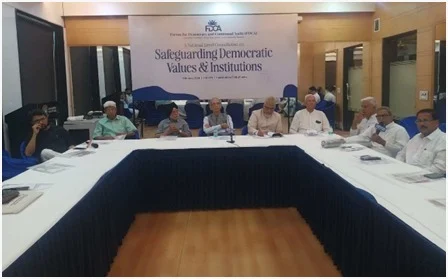
The Forum for Democracy and Communal Amity (FDCA) organised a National Level Consultation on “Safeguarding Democratic Values & Institutions” at the Constitution Club of India on Saturday, bringing together jurists, academics, activists, journalists, former diplomats, religious leaders, and civil society representatives to deliberate on the challenges facing Indian democracy and explore practical measures to strengthen constitutional values and social harmony.
Chaired by Justice Jaspal Singh, the consultation aimed to move beyond merely discussing the current state of affairs in the country. Participants emphasised the need for actionable suggestions and concrete strategies to address threats to democratic institutions and constitutional principles. Organisers stressed that the success of the gathering would be measured not by the identification of problems, which are already widely recognised, but by the course of action.
Addressing the gathering, Professor Salim Engineer, National General Secretary of FDCA, highlighted the need for a nationwide dialogue to address the growing challenges confronting India’s democracy, constitutional values, and social harmony. Welcoming participants to the consultation, Salim Engineer announced that FDCA plans to organise similar consultations in different states over the coming months.
Salim Engineer observed that India’s freedom was achieved through the collective sacrifices of people belonging to all communities and that the Constitution was adopted to guarantee equality, liberty, justice, and fraternity for every citizen. He noted that the Idea of India, rooted in diversity, inclusiveness, and mutual respect, has enabled remarkable progress in science, technology, education, agriculture, health, industry, and other sectors over the past eight decades.
He expressed concern over what he described as a rapid decline in democratic values and institutions during the last 12 years. Constitutional principles are being weakened, social harmony is under strain, and attempts are being made to replace the inclusive vision of India with politics based on hatred and division. He raised concerns regarding voter rights, mechanisms such as the SIR, laws including CAA and NRC, and the weakening of democratic institutions.
He further pointed to issues like hate speech, communal polarisation, mob lynching, suppression of dissent, and the criminalisation of protest. Describing Indian politics as being dominated by four Cs – Criminal, Communal, Corporate, and Corrupt forces – he called upon citizens to reclaim their democratic power and strengthen constitutional values.
Professor Ram Puniyani, historian and President of Maharashtra chapter of FDCA, examined the historical roots of the current political and social climate. He said the RSS built its politics on two foundations: the glorification of an idealised ancient past and hostility toward Muslims and Christians. He said that this long-term campaign of hatred has contributed to social polarisation and communal tensions across the country.
Puniyani expressed concern that even educated sections of society are increasingly influenced by communal rhetoric and that the values associated with the freedom movement, the Constitution, and leaders such as Gandhi and Ambedkar are being sidelined. He accused the RSS and BJP of opposing these values while using social engineering strategies to mobilise support among Dalits, tribals, and other marginalised groups.
Describing hatred as the greatest challenge, Puniyani stressed the importance of combating it through education, dialogue, and public engagement. He urged civil society organisations, NGOs, social movements, and community groups to unite around the shared objective of defending constitutional values rather than remaining divided by ideological differences.
He also highlighted the widening divide between Hindus and Muslims and called for renewed efforts to rebuild social harmony through cultural interaction, community-based programmes, and grassroots initiatives. He praised campaigns such as the Samvidhan Bachao Abhiyan for raising awareness about constitutional rights and democratic values through innovative methods.
Puniyani criticised what he described as attempts to weaken democratic institutions and voiced concerns regarding electoral processes. He urged citizens to participate actively in social movements, support the struggles of workers, farmers, students, women, and minorities, promote independent media, organise community discussions, and defend the principles of equality, justice, and secular democracy. He said only collective action and unity can help create a more inclusive and harmonious society.
Acting President Advocate N.D. Pancholi emphasised the need to revive the spirit that inspired the foundation of FDCA. He said strengthening the organisation requires adapting its mission to meet contemporary challenges while remaining faithful to its objectives.
O.P. Shah, Chairman of Centre for Peace and Progress, called for dialogue not only within India but also with neighbouring countries like Bangladesh and Pakistan. He emphasised that such engagement could contribute to peace in the region.
Former diplomat Ashok Sharma suggested exploring effective ways to curb polarisation and cautioned young people against provocation, stressing that avoiding polarisation is essential for maintaining social cohesion.
Senior journalist Jaishankar Gupta remarked that India is passing through a state of undeclared emergency, which he argued is more difficult to challenge than a formally declared emergency. He advocated greater dialogue and stronger people-to-people contact as a means of addressing present concerns.
Father M.D. Thomas observed that India faces significant challenges. He urged like-minded individuals and groups to reflect on how democratic institutions can be protected and strengthened while also charting a path forward.
Sardar Daya Singh emphasised the importance of identifying the root causes of existing problems before attempting to formulate solutions. He argued that understanding the source of challenges is essential for developing effective responses.
Justice T.C. Rahul focused his intervention on solutions, noting that people are already aware of the central problem of hate. He called for identifying both the tools and the targets necessary to effectively address the issue.
Professor Ajit Jha described the current situation as more serious than can easily be expressed, stating that conditions have deteriorated from bad to worse. He cautioned that effective initiatives could be labelled illegal and therefore stressed the importance of preparing concrete proposals to meet emerging challenges.
Senior journalist Aditya Nigam discussed the role of media in promoting hate content and contributing to the spread of polarisation narratives. He underscored the need to critically examine media practices and their impact on public discourse.
Salimullah Khan, President JIH Delhi, suggested organising a variety of programmes, including cultural activities, to promote fraternity among communities. He also emphasised the need for greater participation and engagement of youth and women in such initiatives.
Colonel Zafri urged participants to focus on solutions and expand the reach of the Forum across the length and breadth of the country.
Professor Nandita Narayan highlighted the difficulties facing the education sector and described the challenges encountered by students and teachers. She drew attention to the pitiable state of the educational system and called for greater attention to these concerns.
Father Vijay Pal advocated the promotion of Sadbhavna Manch in all states as a means of fostering social harmony and strengthening community engagement.
Advocate Touseef Khan of Kolkata High Court emphasised the crucial role of judiciary in safeguarding democratic values and constitutional principles, particularly in light of the challenges confronting the country.
Comrade Nisha expressed her solidarity with the objectives of FDCA and reaffirmed her commitment to the organisation’s cause.
Earlier, Rajasthan State President Sawai Singh delivered the welcome address and greeted participants attending the national consultation.
The event concluded with a collective call for strengthening democratic institutions, defending constitutional values, promoting communal harmony, and developing practical initiatives to address contemporary challenges. The programme was moderated by Nadeem Khan, National Secretary of APCR.