

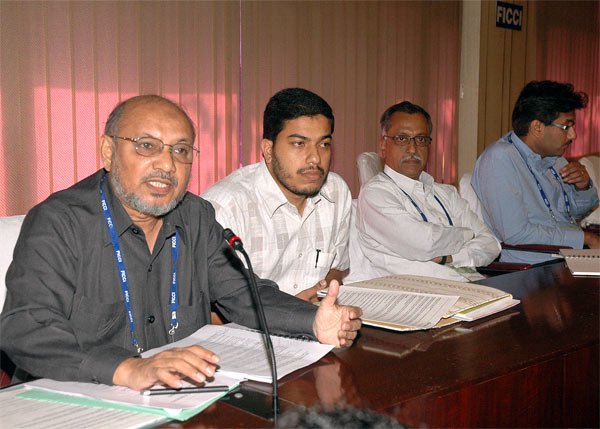
Abdur Raqeeb presenting the case of Islamic Banking at FICCI conference
Federation of Indian Chambers of Commerce and Industry (FICCI), organised a two-day conference of corporate sector players along with government regulators, policy makers and businessmen on “Financial Inclusion for Sustainable Development” in the capital on September 15 and 16.
Dr. C. Rangarajan, former RBI governor, and former chairman of Economic Advisory Council to Prime Minister inaugurated the conference with his keynote address.
Pointing out in the session on “Strategies and Approach Towards Financial Inclusion,” Mr H. Abdur Raqeeb, National convener of Islamic Banking Committee (ICIF) said, “The majority of the unorganised sector workers, semi-skill persons, small farmers are non-bankable because, security problems are needed “equity finance” instead of “debt finance” and access to finance by the poor and the vulnerable groups is a prerequisite for poverty reduction and social cohesion.”
He said that Muslims’ key segment of the population of the country didn’t like to participate with the interest based banking and financial institutions. He quoted the findings and details of “Justice Sachar Committee” and Dr Arjun Sen Gupta report “National Commission for Enterprises in the Unorganized Sector” which revealed that 77% of India’s population earn less than Rs 20 a day and were officially designated “poor and vulnerable” segment of the Indian population, among them were marginalised like unorganised workers, SC /ST and Minorities mostly Muslims.
Mr Raqeeb, who is also on the Central Advisory Council of Jamaat-e-Islami Hind, mentioned the success story of Islamic Banking in modern secular countries like UK, USA, Singapore, Thailand and Japan, whereas the response of Indian government was not positive. Mr Anand Sinha Commission of RBI ruled out Islamic Banking in India in the year 2006 and he lamented that the contents of the report was neither known nor placed in public domain.
Mr Vijay Mahajan of BASIX emphasised to focus the exclusion of the society in terms of segments like community based and gender based. He pleaded for Islamic Banking for Muslims of the country. Mr Vikram Akula, CEO and founder SKS Microfinance lamented on the “financial apartheid” of the regulators as one of the main causes of exclusion of the majority of the population in terms of growth.
Mr Raqeeb highlights that the Islamic Banking is not Muslim specific because 40% customers in Malaysia and 10-20% in Britain are non-Muslims in the Islamic Banks. “If adopted in India it will be beneficial to all segments of the society and a boon to the marginalised and minority community.”
Referring the subprime mortgage crisis and latest Lehman bankruptcy, he held that Islamic Banking and particularly Islamic bonds – Sukuks – are emerging as an answer to them. He called upon the RBI to amend its banking regulations to accommodate Islamic Banking or at least provide Islamic Windows in the conventional banks and also direct IDRA to allow Takaful – Islamic insurance in the country.
Mr N K Maini, chief general manager, Small Industries Development Bank of India (SIDBI), mentioned that there are a few Shari’ah compliant micro finance institutions operating in UP.
A delegation of ICIF met Dr Rangarajan and presented him two documents; one containing the details of Islamic Banking/ Islamic Products in modern secular countries like Britain, Singapore, USA, Thailand, Japan and Sri Lanka and the other on showing developments taking place in the West towards Islamic Banking. Mr Raqeeb also met Dr Amit Mitra, Secretary General, FICCI and pleaded for a special conference of FICCI focusing the importance and relevance of Islamic Banking in India in the context of “Financial Tsunami” that has taken place on the same day in the form of Lehman bankruptcy to which Mr Mitra readily accepted.
A copy of the PPT by Mr Raqeeb on the “Relevance and Need of Islamic Banking in India” was circulated by FICCI to all the delegates and was widely appreciated.
There were five sessions focusing different aspects of the theme and the discussion on the inclusive growth of the largest segments of the population, not only a few “islands of prosperity” but also far more “oceans of poverty” in the country.