

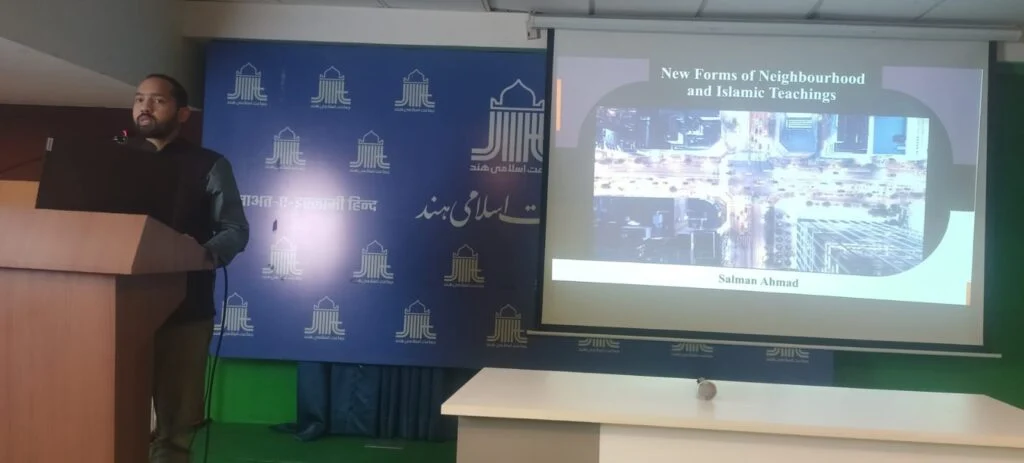
Speaking at Jamaat-e-Islami Hind (JIH) headquarters on November 22, JIH Secretary Salman Ahmad delivered an insightful and reflective lecture on “New Forms of Neighbourhood and Islamic Teachings”. He explored how rapid technological advancements have transformed the idea of neighbourhood, reshaped human relationships, and created both unprecedented opportunities and serious challenges for contemporary society.
Ahmad began by noting that in today’s world, “people’s faces are changing, their forms are changing”, a metaphor for the evolving nature of human interactions shaped by science, technology, and communication revolutions. These developments, he said, have enabled extraordinary levels of connectivity, allowing people to speak with others across continents, transcending barriers of language, race, culture, and lifestyle. Yet, this very transformation has also produced a paradoxical crisis: while individuals feel closer to those far away, they often become disconnected from those who live physically closest to them.
To illustrate this crisis, Ahmad recalled a tragic incident from Delhi’s Rangpuri area. A carpenter named Hira Lal Sharma, living with his four daughters in a multi-storey building, succumbed to extreme loneliness and distress. Despite living among 12 to 15 other families, Sharma remained isolated, deeply reserved, grieving the loss of his wife, and caring for four daughters suffering from various mental and physical challenges. His neighbours, caught up in the fast pace of urban life, rarely interacted with him, nor did they inquire about his welfare even after his wife’s demise.
Eventually, overwhelmed by responsibilities and depression, Sharma poisoned his daughters and committed suicide. His death went unnoticed until neighbours complained of a foul smell. Reflecting on the tragedy, many residents confessed their regret: “We should have knocked on his door. We should have asked how he was managing,” they told investigators. Ahmad said this heart-breaking incident reveals how the absence of emotional and social support systems can push vulnerable individuals toward irreversible decisions.
“This is the crisis of the modern world,” he remarked. “A person digitally makes many friends, but physically becomes disconnected. The rights of neighbours are forgotten, and the consequences can be devastating.”
From here, Ahmad transitioned into the central theme of his lecture: how Islamic teachings on neighbourliness can be applied to modern, diverse forms of neighbourhoods, both physical and digital. He structured the remainder of his talk into several sections: the traditional importance of neighbourhood in Islamic thought, the Prophet’s teachings on the rights of neighbours, and the application of these principles to contemporary forms of human interaction.
He identified multiple benefits of good neighbourhood: emotional and social support, a sense of belonging, enhanced security, resource sharing, emergency help, cultural exchange, and collective action for civic issues. “A child may be born to one couple,” he said, “but the entire neighbourhood participates in its upbringing.” A harmonious neighbourhood, he noted, improves not just individual well-being but the overall quality of life.
Referring to Islamic teachings, Ahmad summarised 10 key principles regarding neighbours: kindness, avoidance of harm, protection of dignity and privacy, offering moral and financial support, sharing food and necessities, refraining from belittling gifts, ethical conduct in markets, proper behaviour during travel, fulfilling rights of classmates and colleagues, and extending compassion to migrants and refugees. These teachings, he argued, present a holistic framework that remains profoundly relevant today.
He emphasised that modern society requires applying these classical teachings to new forms of neighbourhoods, especially digital ones. Social media, he said, has created a new category of “digital neighbours” connected through Facebook, WhatsApp, and other platforms. Yet digital interactions often lack respect, restraint, and verification. The culture of trolling, fake identities, misinformation, and invasion of privacy reflects a departure from Islamic ethics.
Ahmad highlighted four essential principles for interacting with digital neighbours. First, treating them with respect. “People think that because virtual neighbours don’t know them personally, they can say anything,” he said, condemning online abuse and harassment. Second, verifying information before forwarding it. Just as one would avoid sharing unverified news in a physical neighbourhood, one should be responsible online. Third, practising the Qur’anic principle: “Speak good or remain silent.” Fourth, respecting privacy and avoiding unethical digital behaviour such as hacking, stalking profiles, or manipulating images using AI tools.
Ahmad further discussed additional modern contexts where neighbourly ethics apply: fellow passengers during long journeys, colleagues at schools and colleges, business companions in markets, and neighbours in hospitals. He particularly emphasised the moral obligation toward refugees and migrants, urging society to view them not as burdens but as neighbours deserving dignity, compassion, and support.
The lecture concluded with a call to re-examine the meaning of neighbourhood in a rapidly changing world. While technology has redefined proximity and social structures, Ahmad urged listeners to preserve the timeless values of empathy, connectedness, and responsibility toward those around them. He argued that Islamic teachings provide a comprehensive moral blueprint for rebuilding bonds, whether with physical neighbours next door or digital neighbours across the world.
In an age defined by unprecedented connectivity but deepening loneliness, Ahmad’s message was clear: rebuilding neighbourhoods, real and virtual, is essential for a humane, resilient, and ethically grounded society.