


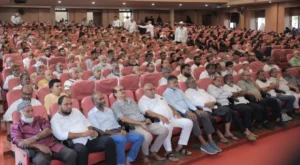
 In a decisive response to what many view as the selective erasure of history, a significant gathering of scholars, writers, and public intellectuals convened at the city’s Purabhavana Hall, Mangaluru. Their unified message resonated against the backdrop of rising historical revisionism: history must illuminate society, not obscure it.
A Call for Authentic Narratives
The seriousness of the moment was evident in the inaugural address delivered by Mohammed Kunhi, Administrator of Shanti Prakashan. Kunhi spoke candidly, stressing the publishing industry’s crucial role as a strong safeguard against manufactured ignorance.
“We face a time when the profound and inseparable contributions of Muslims are being steadily removed from public memory,” he said. “To counter these misconceptions and foster genuine understanding, we must flood the public sphere with authentic historical works.”
Kunhi then announced the release of the Kannada translation of Social Development of India and Muslims, originally written in Malayalam by K.T. Hussain and translated into Kannada by ArfaManchi,Associate Editor of Sanmarga. The book was described as a vital work that directly challenges exclusionary historical narratives.
“This is more than a book; it’s a historical mandate,” Kunhi added. “Its content is supported by over a hundred history texts published between 1858 and 1947. It is essential for preserving the true legacy and social progress of Muslims in India.”
In a region like coastal Karnataka, often marked by communal tension, the publication of this text in Kannada stands as a timely and courageous intervention. Shanti Prakashan was widely commended for bringing such an important work into public discourse and organising a seminar that matched the seriousness of the subject.
History as a Light, Not a Burden
Delivering the keynote address, Dr.PurushottamBilimale, Chairman of the Kannada Development Authority, opened with a striking reminder:“History should not be a burden or dust to our eyes, but a light in our lives.”
He emphasised that many aspects of India’s social evolution, from changes in caste dynamics to advancements in medicine and architecture, cannot be understood without acknowledging the contributions of Muslims.
“Islam did not enter India as a religious force but as a social force,” he explained. “Many oppressed by the caste system embraced Islam. To call this ‘conversion’ is inadequate.”
Expressing concern over changes in educational curricula, he warned:“Erasing Muslim rule from NCERT textbooks is an intellectual weakness for the nation.”
Dr. Ram Puniyani: Challenging Distorted Narratives
Renowned historian Dr. Ram Puniyani from Mumbai said that deliberate distortions by ideological groups have created “walls of hatred” between communities.
“These walls must be broken, and the flowers of love must be allowed to bloom,” he remarked.
He pointed out how selective use of history is weaponised:“Aurangzeb may have destroyed ten temples but granted donations to hundreds. Kashmir’s King Harshadeva destroyed more temples than any other ruler. Some organisations ignite hatred by selectively using history – conflicts that ultimately serve political interests.”
He stressed that temple and mosque demolitions in medieval India were driven largely by wealth, not religion:
“No ruler destroyed places of worship for religious reasons. They did so for economic gain.”
Citing Mahmud Ghazni, he noted:“He attacked the Somnath temple for wealth, and he also destroyed Multan’s Jama Masjid. Among his twelve generals, five were Hindus.”
He added that many groups spreading extremism today “had no role in the freedom struggle” and aim only to divide society.
Dr. Puniyani urged that the findings of the newly released book be made accessible in simplified formats:“Short, clear videos based on the book would help people understand what history truly says – not what some groups want them to believe.”
A Shared Military History
Dr. Puniyani further emphasised connections often ignored in communal narratives:“Muslim soldiers served in Hindu kings’ armies, and Hindus served in Muslim rulers’ armies in significant numbers.”
Prof. Syed Aqil Ahmad: A Legacy of Knowledge
Inaugurating the event, Prof. Syed Aqil Ahmad, founding Vice Chancellor of Yenepoya University, said:“While Muslims may not play a major role in contemporary India, their historical contributions to technology and knowledge are immense.”
He urged the community to nurture more researchers and academics.
A Call for Ethical Engagement with History
Presiding over the event, AbdussalamPuttige, Editor-in-Chief of Vartha Bharati, reminded the audience that a community’s worth lies not only in its past contributions but in its present ones.
“The status of any community should be determined by its current contributions, not solely by the deeds of its ancestors.”
He cautioned against using selective history to create division:“If a member of a united family highlights only one side of the household’s contributions, it can destroy the family.”
Addressing debates surrounding conversion, he stated:“India’s kings are not our ancestors; the original inhabitants of this land are. DNA tests confirm this. Even if forced conversions had occurred, people could have reverted to their old faiths. Instead, generations voluntarily embraced Islam.”
He added:“Monopoly is against the fundamentals of Islam. The Prophet ﷺ was not a king; he lived among people. Islam gives ordinary people the right to question rulers.”
A Timely Book for a Troubled Time
Social Development of India and Muslims examines the social and cultural evolution of India from 1858 to 1947, a period often oversimplified or misrepresented in mainstream narratives.
At a moment when history textbooks are being rewritten to minimise Muslim contributions, both the seminar and the book serve as important counter-narratives.
A Request for Wider Access
The writer of this report wishes to highlight a sincere appeal:this book deserves to be translated into English and Hindi so that a wider audience, especially young Muslims and secular-minded citizens, can access its valuable insights.
At a time when historical distortion is widespread, such translations would play a crucial role in promoting accurate understanding.
History as a Shared Inheritance
The seminar concluded with a powerful reminder that India’s history does not belong to any single community.
As Dr.Bilimale said:“Let history be light, not dust to the eyes.”The responsibility now lies with educators, writers, translators, and concerned citizens to preserve that lightand ensure it reaches future generations before it fades.