

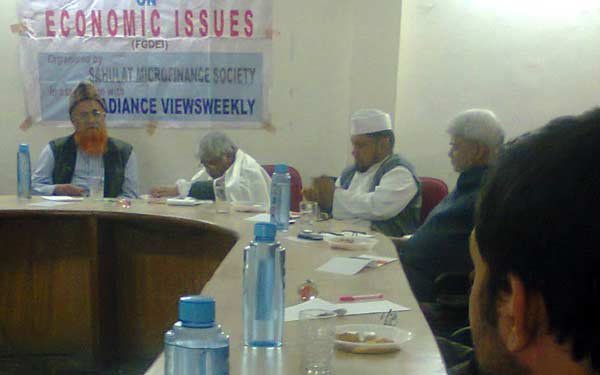
Usama Khan, Deputy Manager (Operations & Research) Sahulat Microfinance Society, explored the positive aspects, feasibility, challenges and grey areas of Pradhan Mantri Jan-Dhan Yojana (PMJDY) scheme, at a programme organised by Forum for Group Discussion on Economic Issues (FGDEI), a joint forum of Sahulat and Radiance Viewsweekly,in the national capital on 29 November.
Usama Khan, during his presentation, outlined that PMJDY has been envisaged to ensure access to various financial services like availability of basic savings bank account, access to need based credit, remittance facility, insurance and pension to the members of excluded sections i.e. weaker sections and low income groups. Earlier also, various measures were taken up by RBI/ GoI like Nationalisation of Banks, expansion of Bank branches network, establishment and expansion of cooperative and RRBs (Regional Rural Banks), introduction of PS lending, Lead Bank Scheme, formation of SHGs and State specific approach for Govt. sponsored schemes to be evolved by SLBC (State Level Bankers’ Committee).
RBI, in the year 2006, with the objective of ensuring greater financial inclusion and increasing the outreach of the banking sector, decided in public interest to enable the banks to use the services of NGOs/SHGs, MFIs and other Civil Society Organisations as intermediaries in providing financial and banking services through use of “Business Facilitator and Business Correspondent Model”.
Some figures were also shown to simplify the requirement and viability of such measures undertaken. Census 2011 estimated that out of 24.67 crore households in the country, 14.48 crore (58.7%) households had access to banking services. Of the 16.78 crore rural households, 9.14 crore (54.46%) were availing banking services. Of the 7.89 crore urban households, 5.34 crore (67.68%) households were availing banking services. Public Sector Banks (PSBs) including RRBs have estimated that by 31 May 2014, out of the 13.14 crore rural households which were allocated to them for coverage, about 7.22 crore households have been covered (5.94 crore uncovered). It is estimated that 6 crore households in rural and 1.5 crore in urban areas need to be covered.
On 15th August 2014, PMJDY was announced by Prime Minister in his Independence Day speech. The initiative has been categorised as a National Mission on Financial Inclusion encompassing an integrated approach to bring about comprehensive financial inclusion of all households in the country.
The plan envisages universal access to banking facilities with at least one basic banking account for each and every household. It ensures financial literacy and access to credit, insurance and pension facilities. The plan also envisages channelling all Government benefits (from Centre / State / Local Body) to the beneficiaries’ accounts and pushing the Direct Benefits Transfer (DBT) scheme of the Union Government.
The benefits under this scheme are categorised as zero balance account, RuPay Debit Card, overdraft facility of Rs 5,000, accidental insurance of Rs 1,00,000 and life cover of Rs 30,000.
Usama also identified the challenges in the implementation of the mission which includes Telecom connectivity in tribal and hilly areas, keeping the accounts “Live”, brand awareness and sensitisation, commission to bank on Direct Benefit Transfer (DBT), coverage of difficult areas.
Some loopholes were also figured out. PMJDY has been bypassing the KYC (Know Your Customer) norms that are mandatory for regular savings accounts according to RBI policy. There are chances of repetition. According to the scheme, overdraft facility may be provided only for Aadhaar card linked accounts; if this is a requisite, it foils the very need of a bank account without identification documents. Reports suggest that even though the government is targeting to open 7.5 crore bank accounts under the scheme, the life policy could be issued to only around 2-3 crore people because of the following riders: Only those who are above 18 and below 59 will be eligible for the life cover. Though the accounts are not mandatorily linked to the Aadhaar numbers, the life cover is strictly open for only those who have the Aadhaar numbers.
In his concluding remarks, the learned speaker raised some valid concerns which require to be answered. They include unclear funding for banking correspondent model finance, cost of overdraft facility, no clarity on who shall bear the cost, how a pool of fund will be evolved for overdraft, has the government got any role to be played by NGOs, MFIs, POs, Cooperatives, model of financial literacy, role of other stake holders, and above all sustainability of this model.