

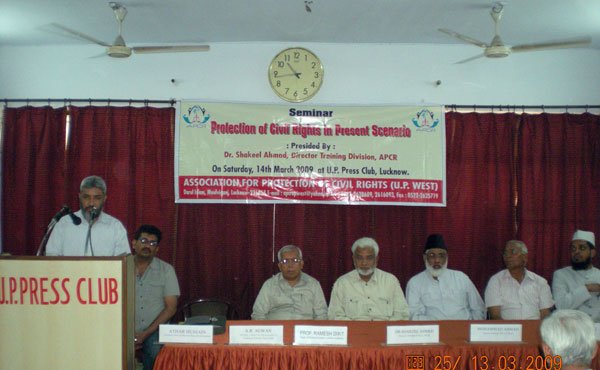
March 7 was a historic day for Aligarh Muslim University in the sense that it was the day when the University opened a national seminar on “Minority Education in India: Issues of Access, Equity and Inclusion”.
Deputy Chairman, Rajya Sabha K. Rahman Khan made a strong plea for re-launching the Aligarh movement for the empowerment of Muslims. The movement needs to be launched with vigour in the backdrop of the Sachar Committee report, he said while inaugurating the seminar organised by the University’s Centre for Promotion of Educational and Cultural Advancement of Muslims of India (CPECAMI).
Mr. Khan urged the minority community to take new initiatives to address the vital issue of their educational backwardness. Muslims should not repeat the mistake of always seeking help from different quarters and crave for sympathy. They have to stick to the principle of self help if they want to change their destiny.
He also urged the Muslims to draw an agenda for the next 10 years to attain self-reliance in education and serve the country through education. Muslims should plan to establish at least one university in each state in the next 10 years. They should also plan to achieve excellence in educational institutions.
In his keynote address, Chairman, National Commission for Minorities Educational Institutions (NCMEI) Justice M.S.A. Siddiqui said the Constitution of India has special provision for minorities as Article 30 recognises minorities’ right to education. Speaking as a Guest of Honour, he urged the Muslims to pay more attention to professional education if they want to redeem their future. “If a minority institution finds any difficulty in getting affiliation and no objection certificate from the state, it can approach the Commission,” he said.
Justice Siddiqui then went on to say that minorities have been given the right to establish their own institutions and manage them according to autonomous rules and regulations. Tracing the history of such institutions, he said there was a time when minority institutions could not seek affiliation from other universities. With the establishment of NCMEI, however this problem has been rectified. He also emphasised that in case a university refuses to affiliate a minority institution, the commission would intervene.
Another Guest of Honour, noted Urdu Journalist and Member of Parliament Ahmad Saeed Malihabadi, while delivering the felicitation address, said Aligarh has played a dynamic role in propagating education among the Muslim minority and it will continue to provide intellectual leadership for Muslims across the country.
Delivering the Presidential Address, AMU Vice Chancellor Prof. P.K. Abdul Azis said AMU strives for building up a class synergy in the minorities across the country. Sir Syed’s vision and mission has become very relevant today, he said. He asked AMU alumni to set up educational institutions, adding that Muslims should take concrete steps toward utilising Rs. 4000 crores earmarked by the Central Government for Muslim concentration districts.
“The revelation of the Sachar Committee reminds that we cannot wait any longer for an educational revolution to occur among Muslims,” he concluded.
Welcoming the guests, Director CPECAMI Dr. Abdul Waheed said deliberations of the seminar would set the agenda for minority education.
Mr Basheer Thangal, an AMU alumnus from Kerala, quoted empirical data to make the point that as far as educational status is concerned, the Muslim community trails behind other minority communities in India. The main cause of this is lack of sound Muslim leadership. The state of Kerala is, however, an exception. The gap between educational status of Muslims and other minorities there is not too wide.
Maulana Fazlur Rahim Mujaddidi, Rector Jamia Hidaya, Jaipur presented a practical analytical data-based talk about the hurdles and limitations of minority concentration districts. He thanked the UPA government for initiating various welfare schemes but wondered if these schemes actually benefited the minority at the grassroots level.
“Education should receive greater priority than sanitation, health, or housing for Muslims. He recommended that social organisations should come forward with NGOs and form a network from block to national levels,” he concluded.
Member AMU court and Vice–President Kerala Muslim Educational Association B. K. Beeran asserted that as far as employment is concerned the older generation of Muslims is better placed than the younger generation. What needs to be done, continued Mr. Beeran, is to enact a legislation to implement Article 30 of the Constitution and ensure that educational institutions in the public sector are set up at places where there is a population of more than 15% Muslims. Apart from this, NGOs should not only be established but also empowered.
Member Kerala State Public Service Commission V.P. Abdul Hameed remarked that Kerala holds a mirror to the rest of the country and plays a role model for the resurgence of Islam on the socio-cultural, economic and political fronts.
Honorary Secretary MESCO, Andhra Pradesh Dr. Fakhuruddin Mohammed, informed the audience that out of 904 minority institutions in the State, 405 belong to Muslims. Out of 60 minority engineering colleges 36 belong to Muslims. A total of 1600 seats in engineering colleges are available to minorities. As many as 1740 Muslims qualified the CAMCET while 8500 seats were available. Whereas 2500 Christians qualified while seats available were 7000. He predicted that Andhra Pradesh would be the first state to have at least a dozen universities in the next 10 years. He requested the Vice Chancellor to establish an AMU campus in AP.
General Secretary, All India Association for Christian Higher Education Mani Jacob said minority education would be successful and effective only when girls are made part thereof. Otherwise, it will just become an exercise in patriarchy.
Chairman Minority Commission, Delhi, Kamal Farooqui suggested that a website highlighting information and issues relating to minority education should be created as soon as possible. He further said that success stories of Andhra Pradesh and Kerala suggest that we too can replicate them in various states by taking advantage of provisions available to us.
Dr. Nazrul Islam, IPS, I.G., Welfare Kolkata expressed concern about the lack of academic or technical institutions in Muslim majority areas of West Bengal. Dr Islam highlighted other disturbing points as well – such as the fact that no Muslim holds important portfolio in the state ministry; in all political parties, the leaders are upper caste Hindus.
This scribe, who also happened to be convener of the seminar, while emphasising the importance of law for the Muslims, urged the gathering to open law schools and colleges throughout the country. He said there are about 700 districts in India for which Muslims need at least 10 good lawyers each district. In this sense there is an immediate need of at least 7000 lawyers. He forcefully pleaded that good students should be encouraged and motivated to join law as profession.
He also underlined that in all Muslim managed institutions, including AMU, moral education based on the Qur’an and Sunnah should be made compulsory so that Sir Syed Ahmad Khan’s dream of Taleem -o- Tarbiyat (education and good upbringing) can be realised.
Prof. Ehtesham Nizami of AMU expressed the view that education that doesn’t inculcate moral values in the minds of students is bound to prove defective and perfunctory.
Dr Nawas K.M., CEO and Executive Trustee, KMCT Group of Institutions, Calicut, highlighted the problems of minority institutions in India and said a major concern is that it is difficult to get affiliation for colleges from various universities.
Professor Aman Ullah Khan of AMU presented the success story of Iqra Public School, Aligarh.
Prof. A. R. Qidwai, Director Academic Staff College AMU contented that the condition of Muslim Degree Colleges is becoming worse day by day. He quoted convincing facts and statistics in support of his contention.
Prof. Nafees Ahmad, Secretary Nur ul Uloom Society, Aligarh, said the major reason for backwardness of Muslims is failure of High School Quality Education. He forcefully pleaded to develop a comprehensive programme for School Education for Muslims.
Mr. K.K. Aboo Baker, Member National Monitoring Committee for Minority Education, Kerala, asserted that the solutions to our educational problem should come from within the community.
A full session was devoted to the Women’s Education. Speaking in the session, Prof. Marion Mathew, Dean College of Education, AAI Deemed University Allahabad, contented that Muslim women can also play a role in bringing about a change in society. What women need, however, is socio-economic freedom. The voice of suppressed women needs to be heard.
Dr. Bazigha Tabasum made the point that theory must be replaced with practice. The myth that Muslim women can’t progress as long as they remain under the jurisdiction of Sunnah and Shari’ah is fading. The Qur’an and Shari’ah have, in fact, given the world some of its most modern ways.
Prof. Anita Nuna of NCERT lamented that the funds granted for Muslims are often utilised elsewhere. There is a gap not only in the implementation of the schemes but also in awareness about them.
In the Business Session, Prof. C.I. Abdul Rahiman, General Convener Kerala Muslim Engineering College Management Association focused on various institutions that offer professional education in Kerala. He informed the audience that there are 10 engineering colleges for minorities in Kerala, offering a total of 5830 seats. Around 580 Muslims receive free education.
Mr. Mohammed Sharief Quershi of Bihar stated that the educational status of Muslims in Bihar is very poor. There are very few Aanganwadi and primary schools for Muslims in Bihar.
Dr. Mohammad Mazheruddin Khan of Hyderabad, while chairing the session, informed the audience that the government offers 4% reservation in Andhra Pradesh in all government colleges. Moreover, the state government also encourages the community to get a good education by offering scholarships and waiving fees. The Chief Minister of AP recently released Rs. 15 crores for minority education.
More than 400 delegates participated in this two-day seminar with more than 100 delegates coming from outside Aligarh.
The Chief Guest of the Valedictory Session Maulana Mohd. Wali Rahmani said the programmes and schemes meant for the minorities are generally not implemented. It is the duty of the Muslim community to monitor all these schemes. He promised his full support for acquisition of land in Bihar and West Bengal for the proposed Centres of AMU.
AMU Vice Chancellor Professor P.K. Abdul Azis, while presenting “Aligarh Declaration 2009 on Educational Agenda for the Muslims” in the Valedictory Session, urged the Muslim community to focus their energy on converting itself into a totally literate and skilled community with a sizeable portion pursuing higher and professional education. The community should raise itself as a population brimming with self-confidence, character and value-orientation and should be endowed with a vision of national welfare and development in order to integrate itself with the national mainstream.
The seminar called upon the governments in Uttar Pradesh, Bihar, West Bengal and Assam wherein live over 55% of India’s Muslims to emulate the policies and schemes being implemented in States such as Karnataka, Andhra Pradesh and Kerala, to expand the scope of proactive policies to make it inclusive and enable all communities to access higher education (including professional education) in order to ensure equitable share in investments being made in this sector to quicken the pace of economy.
It was the unanimous view of the delegates and participants to re-launch the “Aligarh Movement”, which was originally conceived and given shape by Sir Syed Ahmad Khan. The “Aligarh Declaration” presenting a National Agenda for the Educational Advancement of the Muslim Community as a mandate by AMU Act under Section 5(2)(c), may be considered a step in that direction.
The seminar also urged the Government of India to enact a new legislation to clarify and to implement Article 30(i) more effectively. This will remove the present need for frequent litigations on every issue related to minority rights.
The seminar called upon the Muslim community to launch “A Waqf Movement” to get wakf properties free from encroachment as the wakf properties may yield ample financial resources for launching the massive educational projects across the country.
The seminar appreciated the efforts of AMU Vice Chancellor, Professor P.K. Abdul Azis who is making all out efforts for educational and cultural uplift of the Muslims.